
2025 RET and REU Community
Overview
At RegenPGC, we are building for the future by introducing existing and prospective science/STEM educators to our research portfolio. We participate in two crucial initiatives at Iowa State University: the Research Experience for Teachers (RET) and the Research Experience for Undergraduates (REU) programs.
The RegenPGC RET program allows middle and high school teachers to gain research experiences and establish ongoing relationships with PGC scientists and graduate students. Our goal is for our RET participants to share their RegenPGC experiences with their students upon returning to the classroom and inspire young people to learn more about STEM subjects.
The RegenPGC REU program provides opportunities for undergraduate students interested in future careers as STEM teachers to engage in a hands-on research project under the guidance of RegenPGC mentors.
Both projects take place during the summer months. Maureen Griffin, from the Iowa State University Office of Biotechnology, leads our REU and RET efforts.
Meet the members of the RegenPGC 2025 RET and REU communities in their own words. Learn more about our 2024 RET and REU participants at https://www.regenpgc.org/theme-3-education/2023-ret-reu-programs/.
2025 Research experience for teachers
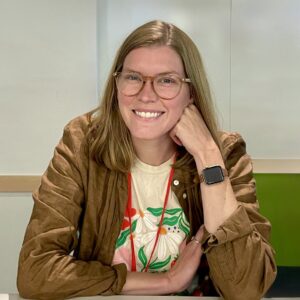
- Dr. Richard Roth & Alioune Diop
Investigating Sulfur Use Efficiency in Perennial Ground Cover Corn Cropping Systems
Research Topic & Goals: Nutrient Management in PGC Cropping Systems
What was your biggest takeaway from your research experience? The most important realization this research has given me is that the doors for learning open with curiosity, relationships, and agency.
Why did you spend the summer with the RET Program? I signed up for the RET program because I’m passionate about bringing real-world, hands-on learning opportunities to my students. I’m always looking for ways to deepen my own understanding of STEM concepts so I can better engage and inspire young learners. This project is a great opportunity to grow professionally, collaborate with others, and bring fresh, research-based ideas back to my classroom.
How do you see this experience impacting your classroom? I see this experience having an impact on my classroom by enriching my teaching with real-world scientific applications and research-based practices. By engaging in hands-on research, I will be able to bring authentic STEM experiences to my students, making science more engaging, relevant, and inquiry-driven. I plan to integrate what I learn into my lessons, incorporating more hands-on experiments, problem-solving activities, and connections to real scientific careers.
My Background… I grew up in Johnston, Iowa, and currently live in Ankeny, Iowa, with my husband and three kids. I earned my degree in Elementary Education from Iowa State University and later completed my master’s degree at Viterbo University. I’ve been teaching 5th grade for 15 years and love engaging students across all subject areas. In addition to classroom teaching, I run a science and engineering club that brings hands-on STEM experiences to young learners. Outside of school, I enjoy spending time with my family, being outdoors, and finding creative ways to make learning exciting. Something unexpected about me? I love to garden —it’s my favorite way to relax and reconnect with nature.
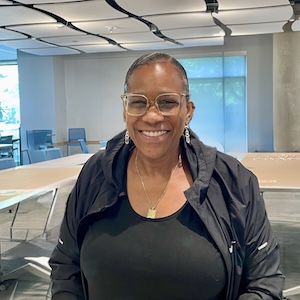
- Dr. Thomas Lüberstedt & Memiş Bilgici
Stomatal Traits in Maize (Zea mays L.): Can we predict from first leaf to ear leaf across yield- contrasting hybrids in Perennial Ground Cover Crops?
Research Topic & Goals: Stomatal Traits in Maize (Zea mays L.): Can we predict from first leaf to ear leaf across yield-contrasting hybrids in Perennial Ground Cover Crops?
What was your biggest takeaway from your research experience? That stomatal measurements can be used to determine which hybrids should be planted along with Kentucky bluegrass (Poa pratensis) and Poa bulbosa as cover crops in order to support targeted breeding strategies and enhance maize performance while improving water efficiency and overall soil conservation.
Why did you spend the summer with the RET Program? I have always enjoyed incorporating biotechnology into my lessons, and I am always looking for new and innovative approaches to teaching
How do you see this experience impacting your classroom? My students will benefit from having additional resources and ways to explore science topics that break the traditional direct instruction model. Opportunities such as this can help to maintain a student-centered learning environment and expose students to new, cutting-edge experiences and techniques.
My Background… I am a native of Orange County, California. I earned a BS in biology education (Claflin University). I taught in South Carolina for 5 years. I have also earned an MA in interdisciplinary studies with a concentration in environmental science and administration (Virginia Commonwealth University) and an MS in pharmacy with a concentration in forensic science (University of Florida).
I have over 30 years of experience teaching middle school science, high school biology, anatomy, forensic science, ecology, and high school summer remediation science classes. I have also served as an instructional specialist for math and science and taught science courses (grades 6 –12) in an alternative school setting. I also taught science at ChallengeU, an online graduation recovery program.
During the spring of 2019, I earned an educational specialist degree in curriculum and instruction. Currently, I teach high school biology and AP environmental science for Richmond City Public Schools in Richmond, VA. The love that I have for science and children can be seen as I expose students to new and exciting concepts and share my travels and research experiences with everyone.
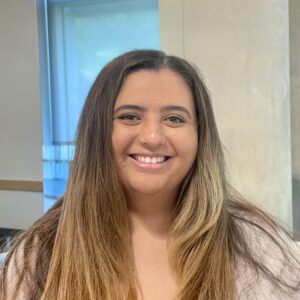
- Dr. Amy Kaleita & Mayok Soetan
Beyond the Green: Decoding Iowa’s 2020 NDVI Spike and its Environmental Drivers
Research Topic & Goals: After noticing a spike in the Normalized Difference Vegetation Index (NDVI) across Iowa in the summer of 2020, we wanted to investigate the reason to see if it’s a replicable change as a means of increasing crop yield in future years.
What was your biggest takeaway from your research experience? I always knew math and science were deeply interconnected, but it’s been great getting to really experience it for myself. Research and examining real world issues can be made accessible at any level, so I’m excited to begin showing my students that same idea
Why did you spend the summer with the RET Program? I have a passion for continuing my own learning, and being able to show my students not only why the math works how it does, but how it can be applied. I always love telling my students about how math and STEM are constantly growing and changing, and what better way to do that then to go help grow and develop research myself.
How do you see this experience impacting your classroom? I would love to incorporate more cross-curricular and project-based learning into my classroom and begin to introduce the students to areas of STEM that they don’t get to explore as commonly at the high school level. I believe this experience will be a great way to collaborate with other STEM areas and begin developing materials based on the research descriptions involving creating and implementing classroom activities.
My Background… I am a high school math teacher in Creston, Iowa, entering my 5th year of teaching. I grew up in Elgin, Illinois, and moved to Iowa for college. I attended Drake University, completing a BA in Mathematics and a Spanish Minor alongside my BSE in Secondary Education. This past summer, I also finished my MA in Mathematics through Texas A&M to begin offering Calc 1, College Algebra, and Statistics for community college credit at Creston High School. I also teach Geometry, Trigonometry, Pre-Calc, and Probability & Statistics. It’s a full load, but I love it!
2025 Research experience for undergraduates
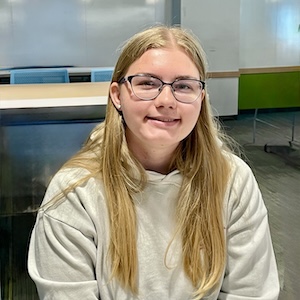
- Dr. Shui-zhang Fei, Patrick Galland & Cameron Krumm
The Effect of PGC Species and Suppression Method on Maize Growth and Development
Research Topic & Goals: To screen for grasses suitable to be used in a Perennial Ground Cover system with corn and compare them under chemical suppression versus without chemical suppression
What was your biggest takeaway from your research experience? It’s that knowing the “why” behind your work completely changes your perspective on your work and how meaningful it is. Once you know the “why” you are then able to connect with the project and devote more focused energy towards it. Additionally, your community has a large impact on who you become. If you spend your time surrounded by people who want to support you and see you flourish, then you will do just that.
Why did you spend the summer with the REU Program? I applied to the REU program because I think it will be a great experience that pushes me to become a better teacher while in q structured environment. This program will allow me to complete hands on research that I can reference when I am working with my own students in the future. Additionally, this experience will push me out of my comfort zone by placing me in a new place where I will have to learn how to navigate around both Ames and Iowa State.
Why do you want to become a teacher? I knew I wanted to become a teacher, but it wasn’t always going to be in a STEM field. I didn’t decide I wanted to become a teacher in a STEM field until last year, but the idea had been growing on me since middle school. While I was growing up, I always excelled in my STEM classes and found myself wanting to learn more. This was due to my amazing teachers in elementary and middle school. My teachers could figure out what I enjoyed and relate my assignments to those things. They gave me extension activities to ensure I was being pushed to my full potential, and they supported me as a whole human, not just as a student.
Additionally, they encouraged me to join the robotics team at my school. By joining this team, I was able to push myself to do my best and think outside of the box when faced with challenges. It also allowed me to see how science and math have practical applications. Due to the amazing experiences I had growing up with my STEM teachers, the idea of becoming one grew on me.
Finally, last year I had multiple different people mention to me that I would be a good science teacher and encourage me to explore that route. Ultimately, I have decided to take that route. I now want to become a middle school science teacher so I can encourage my future students to explore their passions and interests the same way my teachers did for me. I also want to show them that they can do whatever they want if they put their mind to it. The STEM experiences that I had growing up had a huge impact on my decision to teach in a STEM field, and I want to ensure that other kids can have these same (or similar) experiences that I did.
My Background… I am currently a 2nd year Elementary Education Major attending Wartburg College. I am pursuing my K-8 Reading Endorsement and Middle School Math and Science Endorsement. I am originally from Cedar Falls, Iowa. In my free time, I love to sing songs with my friends, ride my bike with my family, and color pictures!
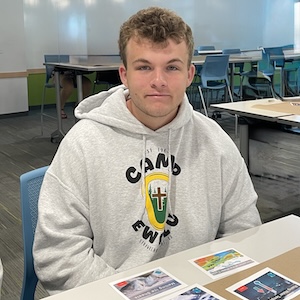
- Dr. Ken Moore, Patrick Galland & Rickiel Rodrigues Franklin da Silva
How Perennial Groundcover Affects Maize Growth: Exploring Shade Avoidance Responses
Research Topic & Goals: I participated in was a project looking into the relationship of soil microbiome to the acquisition of nitrogen by maize plants in low nitrogen soils. To accomplish this, we isolated soil bacteria from maize roots. Bacteria were grown on plates and then sorted into groups based morphological characteristics. PCR was used to identify bacteria belonging to Oxalobacteraceae. These samples were then sent to be sequenced and those that returned as positive for Massilia will be used in future root growth assays. In addition to Massilia isolations, I aiding in performing one such root growth assay on previously isolated Massilia. This assay I helped perform and ones test the response of maize seedlings to the Massilia inoculants as compared to a control (Phosphate buffer). These experiments are motivated by previous research which has shown a relationship between the soil microbiome and the ability of maize to utilize nitrogen in low nitrogen soils.
Why did you spend the summer with the REU Program? My application to the RET/REU program begins from my desire to gain useful experience in math and science that I can bring into my future classroom.
As someone who will be teaching middle school in the future, I understand that real-world learning, particularly in STEM, often requires trial and error and at times, failure. I want to demonstrate to my students that failure is not the end, but rather a component of the learning process. I am aware that I will encounter challenges and difficulties in this program, and I am confident that those experiences will improve my teaching abilities.
When I tackle challenges on my own, I can assist my students in grasping that making mistakes, looking for assistance, and endurance are all accepted actions. It is just as important to learn how to fail in the future as it is to reach at the appropriate response. I desire for my classroom to be a space in which students feel safe, curious, and supported, particularly when challenges arise.
Why do you want to become a teacher? My decision to become a STEM teacher stems from a strong desire to learn and share knowledge. STEM topics always attracted my interest because of their ability to tackle current issues and promote creativity. I hope to inspire the next generation of thinkers and innovators by making these topics more approachable and entertaining. Teaching allows you to spark students’ interest, assist them in understanding complex ideas, and promote critical thinking and problem-solving—all of which are essential abilities in any field.
My Background… I grew up in the small town of Charles City, Iowa. I’m a first-year student at Wartburg College, studying to become a middle school teacher with a focus on grades 5–8 science and math, along with a coaching endorsement. While I’m still gaining experience, I’m passionate about education and excited to help future students grow. I have a twin, and I’ve ridden in RAGBRAI twice, an experience that challenged and inspired me. I love fishing, listening to music, and playing the ukulele in my free time.
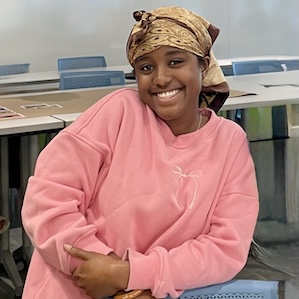
- Dr. Marshall McDaniel & Modestos Modestou
The “S” in Sustainability Should Stand For Soil!
What was your biggest takeaway from your research experience? As an emerging young adult, finding experiences that can introduce me to new careers and opportunities has always been a challenge till now. Many organizations don’t take value or see fit people who have identities like mine. So, being in this research experience, my biggest takeaway is always remembering that there are people and programs out in that world that value what I believe in and who can help push me forward to my goals and dreams. Also, understanding the processes that go behind researching in the STEM field. I feel confident that I can transform and translate what I’ve experienced and witnessed to not only teach but to encourage others to take an interest in STEM fields.
Why did you spend the summer with the REU Program? My personal goal is to gain experience, exposure, and spend my summer being productive.
Why do you want to become a teacher? I would love to show and teach people why I love biology and to open more people to the STEM fields. This will open more research, cures, and job opportunities for people.
My Background… I was born in Freetown, Sierra Leone to parents Mildred Khalil and Mohamed Khalil. Around the age of 7, we moved to the United States, and I spent most of my time here in Des Moines than anywhere else. I graduated from Hoover High School (Des Moines). Some of my experiences include that I’ve been a CNA for 3 years. My passion is human medicine in preparation for med school, so I’m studying biology here at Iowa State University to gain experience. Some of my attributes are that I’m an empathetic person; my love for others has made me who I am today. I’m shy about beginning to get to know people, but once I open up, I’m as sweet as honey. Some of my hobbies are reading, researching new topics, hanging with friends, and genuinely enjoying life and my own company.

- Dr. Ken Moore, Patrick Galland, Cameron Krumm & Amina Moro
How Far Is Far Enough For Optimal Corn Growth In PGC systems?
Research Topic & Goals: Determine the right cropping for corn in the PGC system to minimize competition and maximize yield
What was your biggest takeaway from your research experience? My biggest takeaway from this summer was how to spark and encourage curiosity. I enjoyed finding creative and fun ways to explore my curiosity and had a great time doing it with a great group of people.
Why did you spend the summer with the REU Program? I wanted to grow in my understanding of the research experience.
Why do you want to become a teacher? I have decided to become a STEM teacher because I enjoy the higher-order thinking problems while teaching and connecting them to real-world examples. Also, break the misconception that students are “bad” at math and science. I enjoy connecting the topics with chemistry and velocity problems to help make both enjoyable and collaborative.
My Background… Hello, my name is Jacie Staedtler. I am going to be a senior at South Dakota State University (Brookings, SD) in the fall, pursuing my mathematics education degree. I am from Spencer, Iowa, and stayed in Alta, Iowa, over the summers. I enjoy reading, being on the farm, cooking, and baking. A fun fact about me is that I have written a recipe book for my family.
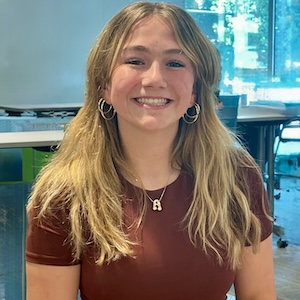
- Dr. Dan Andersen, Dr. Raj Raman & Philip Rockson
Assessing Corn Growth Response to Seed Placement in an RHb PGC system
Research Topic & Goals: Assessing Corn Growth Response to Seed Placement in an RHb PGC system
What was your biggest takeaway from your research experience? It’s that everything that you do, no matter how small it seems will have some sort of impact. So make sure you do everything with intention.
Why did you spend the summer with the REU Program? Because it will be a good experience, and an amazing way to spend my summer.
Why do you want to become a teacher? I was always frustrated in school because I never understood science. In my sophomore year of high school, my teacher helped me understand the content by drawing diagrams for me. Two years later, I had her as a teacher again. The first thing that she said to me that year was, “I remember you learned by diagrams and drawings.” At that point, I realized that I wanted to be able to help students understand science just like my teacher. She made me enjoy science again. I want to be able to do that for others.
My Background… My name is Audrey Tucker. I am 19 years old from Mount Vernon, Iowa. I am currently a first-year student at Wartburg College. I am studying biology and education, and plan to have an endorsement in All-Science. I enjoy running, wrestling, reading, and hiking. Something unexpected is that I play the trombone at Wartburg.