We report, therefore we exist…

We believe in the adage that unless work is memorialized, it doesn’t really exist (except in the dark recesses of someone’s mind). This is why you can follow the investment made by our funder, USDA National Institute of Food and Agriculture, in our perennial groundcover research right here in our latest quarterly report, which you can find here.
Check it out. Visit our website. Send us questions to https://www.regenpgc.org/contact/. That way, we won’t think our work shot out into an unfathomable void!

Poa secunda, a Promising Perennial Groundcover?

RegenPGC Graduate Education Community member Vipul Kumar has been showing his poster, “Vernalization response and freezing tolerance of Poa secunda, a promising perennial groundcover” far and wide, from Texas to Wisconsin. You can check his poster out right here! https://www.regenpgc.org/wp-content/uploads/2026/07/Kumar_Vipul_Poster_FINAL-2.pdf.

Working with RegenPGC Co-Project Director Dr. Shui-zhang Fei, Vipul is investigating the feasibility of using Poa secunda as a perennial groundcover. With support from RegenPGC and USDA NIFA, Vipul has presented his work at numerous professional gatherings, where he has received feedback on his research and presentation skills. Learn more about the RegenPGC Graduate Education Community at https://www.regenpgc.org/theme-3-education/graduate-education-copy/.

Mapping priority areas for runoff and erosion control in Iowa corn landscapes

Floyd River Watershed

Ralph Danquah-Acquah, a member of our RegenPGC Graduate Education Community, shares his research in this guest post, which previously appeared on LinkedIn (July 2026).

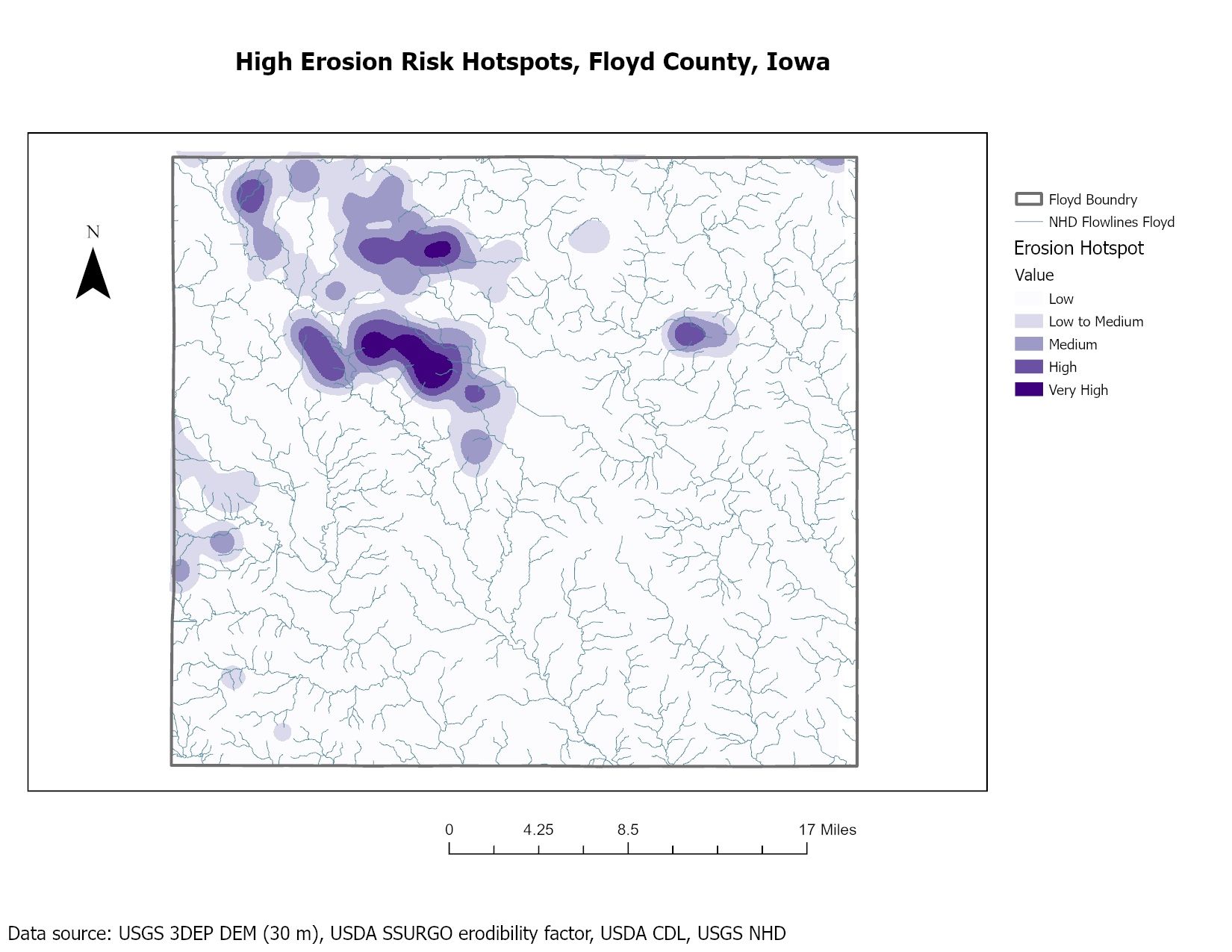
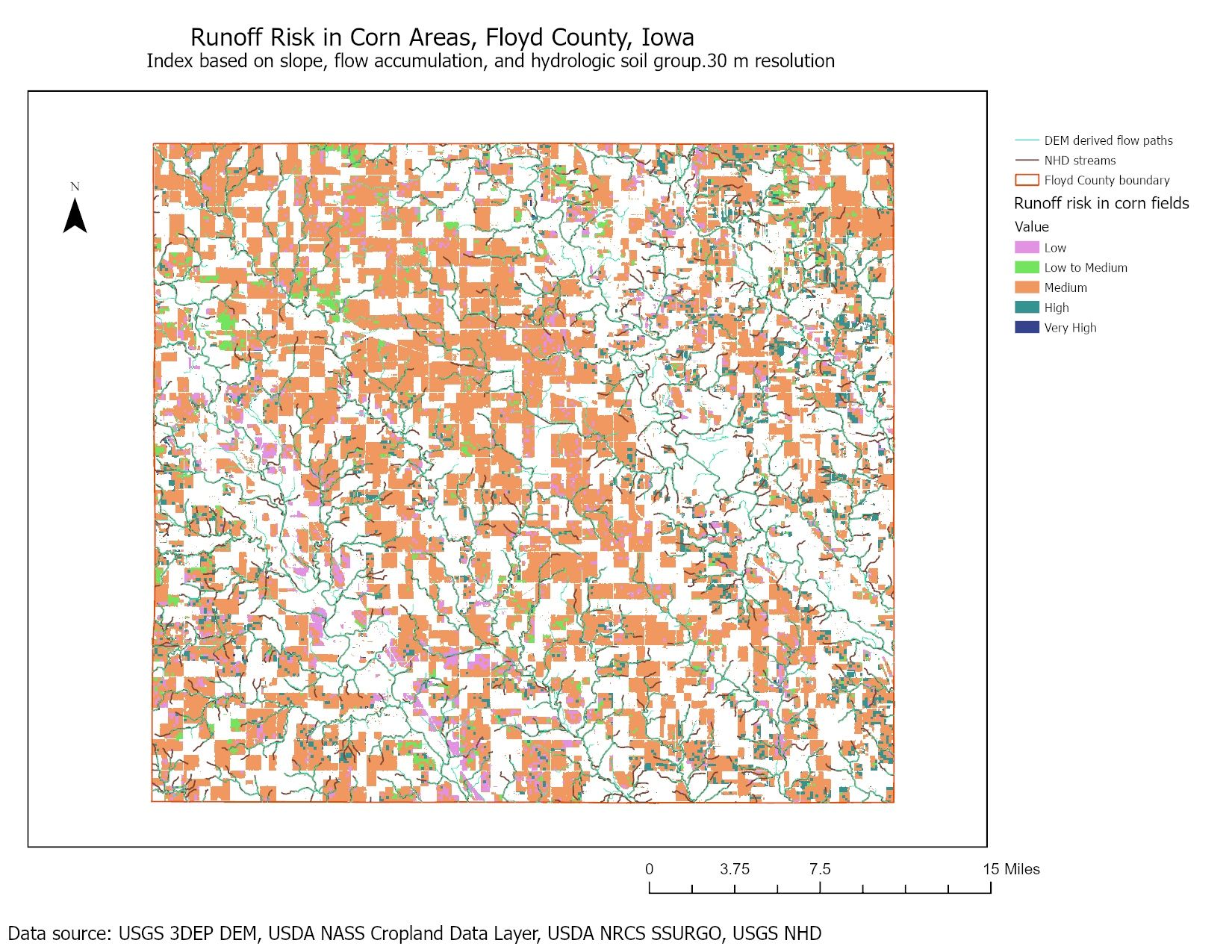
I completed my CRP 5510 GIS final project at Iowa State University, where I developed a GIS-based workflow to map runoff and erosion risk in corn landscapes in Floyd County, Iowa.

The motivation for this project came directly from my ongoing work with the RegenPGC project. My ALMANAC simulation work is connected to the Iowa State University Northeast Research and Demonstration Farm, and since that research location is in Floyd County, I chose Floyd County as the study area for this GIS project.

RegenPGC is exploring how perennial groundcover systems can help make corn production more resilient by reducing runoff, erosion, and other environmental losses. That made me think beyond the field scale and ask a broader spatial question:

If runoff and erosion are major concerns in corn systems, which places should be targeted first?

That question shaped the direction of my project. Instead of only looking at whether a conservation practice can reduce runoff and erosion, I wanted to explore where conservation practices may be most needed across the surrounding agricultural landscape.

The project focused on three main questions:

  • Where is runoff risk highest in corn areas?
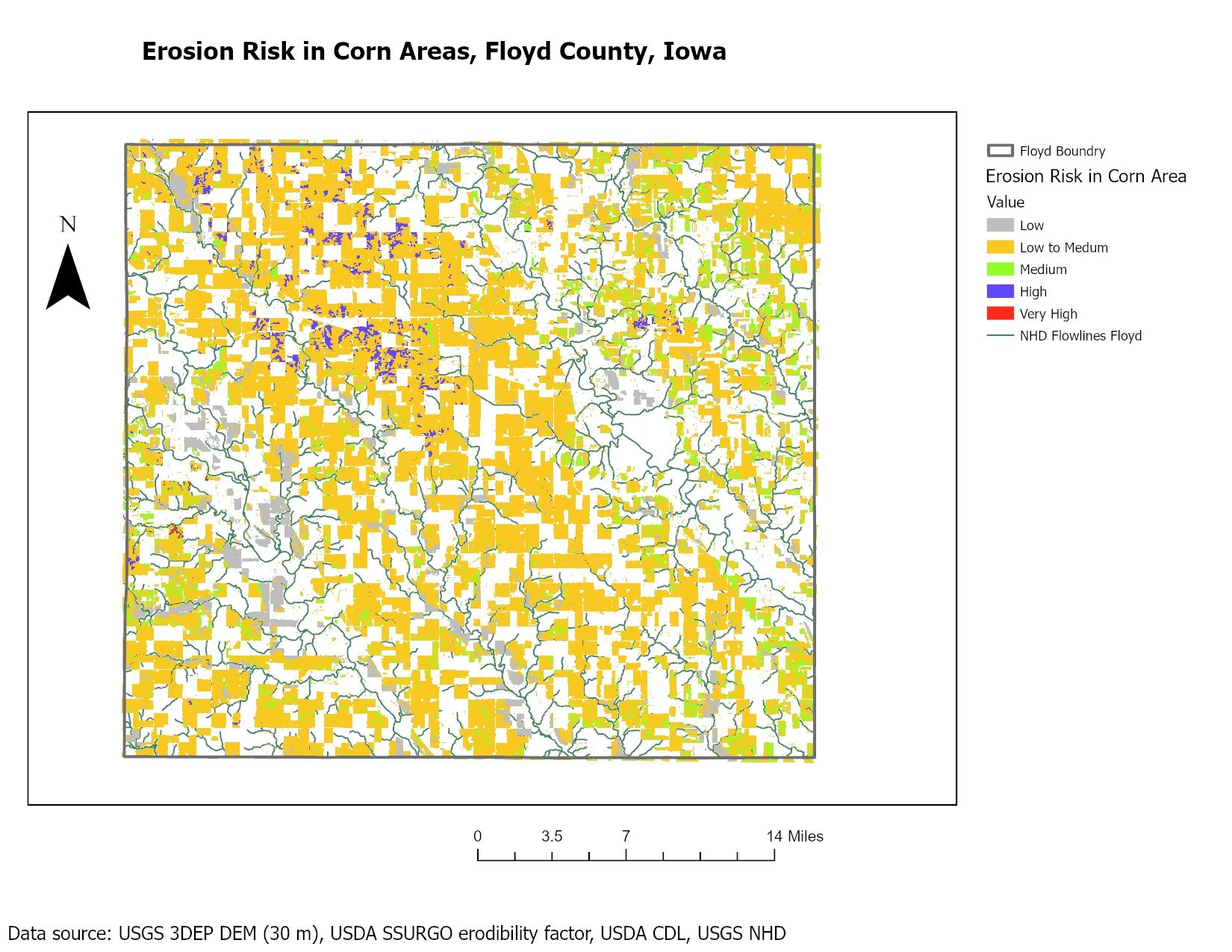
  • Where is erosion risk highest in corn areas?
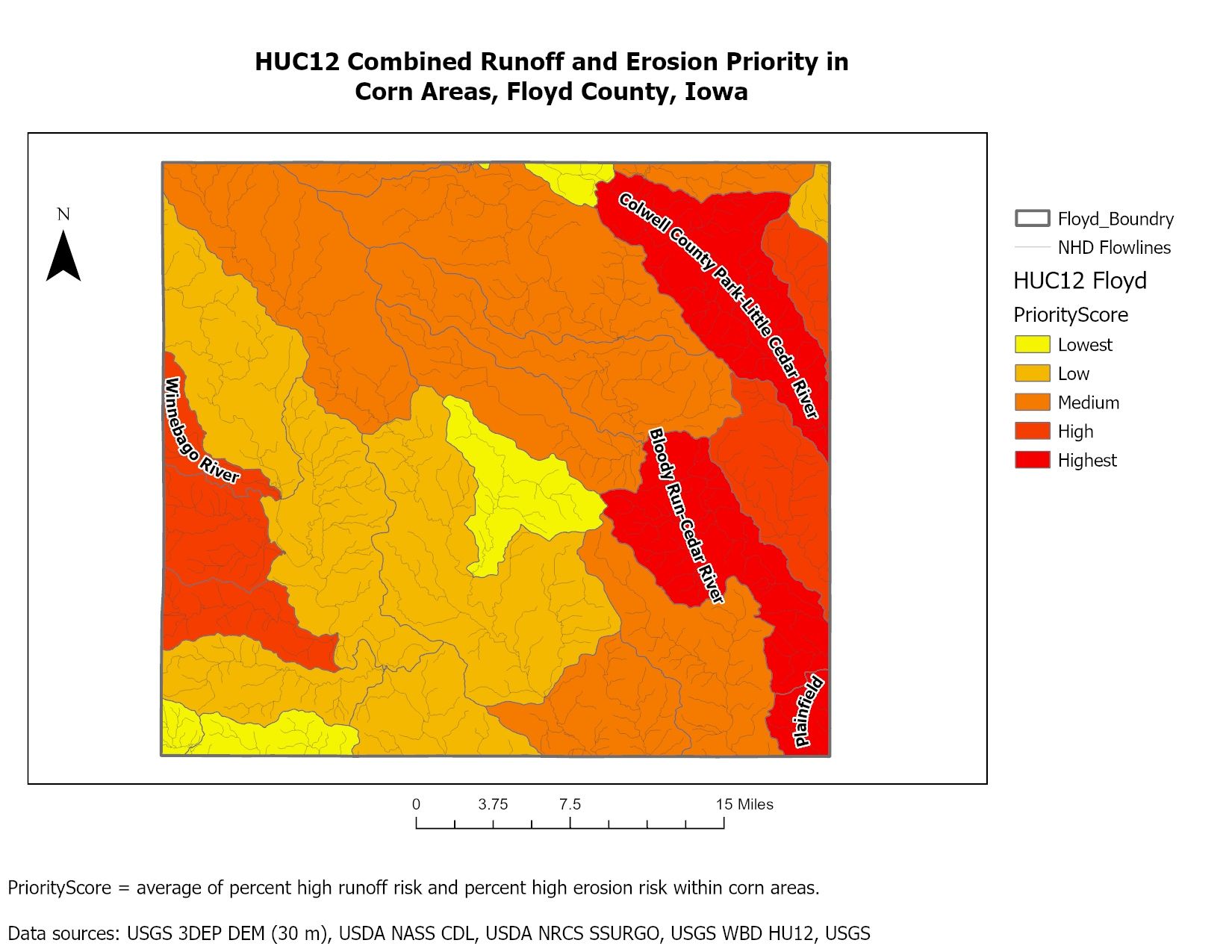
  • Which HUC12 subwatersheds contain the largest risk and high-risk corn land?

Using ArcGIS Pro, I worked with open geospatial datasets including USGS 3DEP DEM, USDA SSURGO soils, USDA NASS Cropland Data Layer, USGS NHD flowlines, and WBD HUC12 boundaries. I created runoff and erosion risk indices, mapped erosion hotspots, and summarized high-risk corn areas by HUC12 to develop a combined priority score.

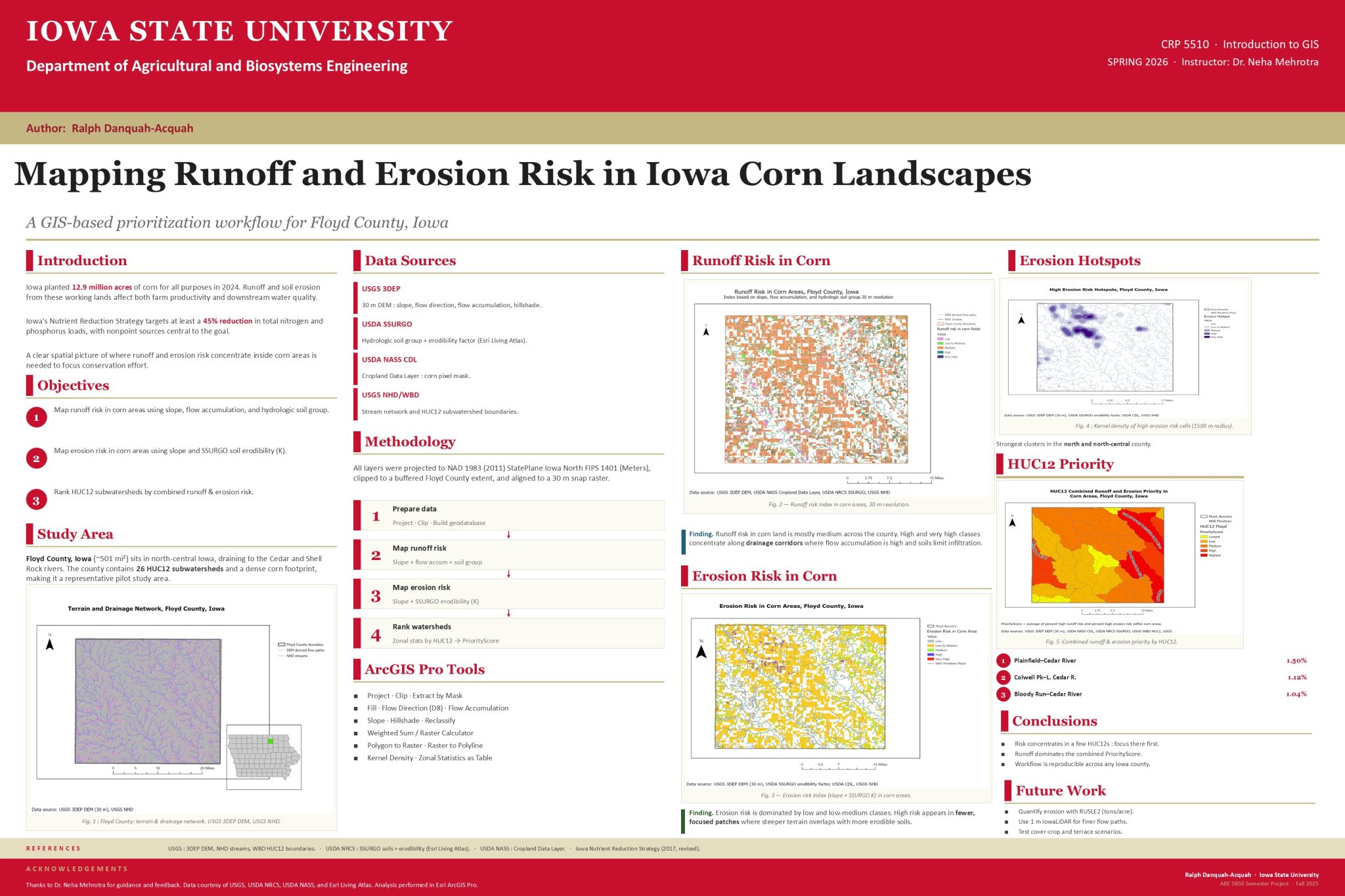
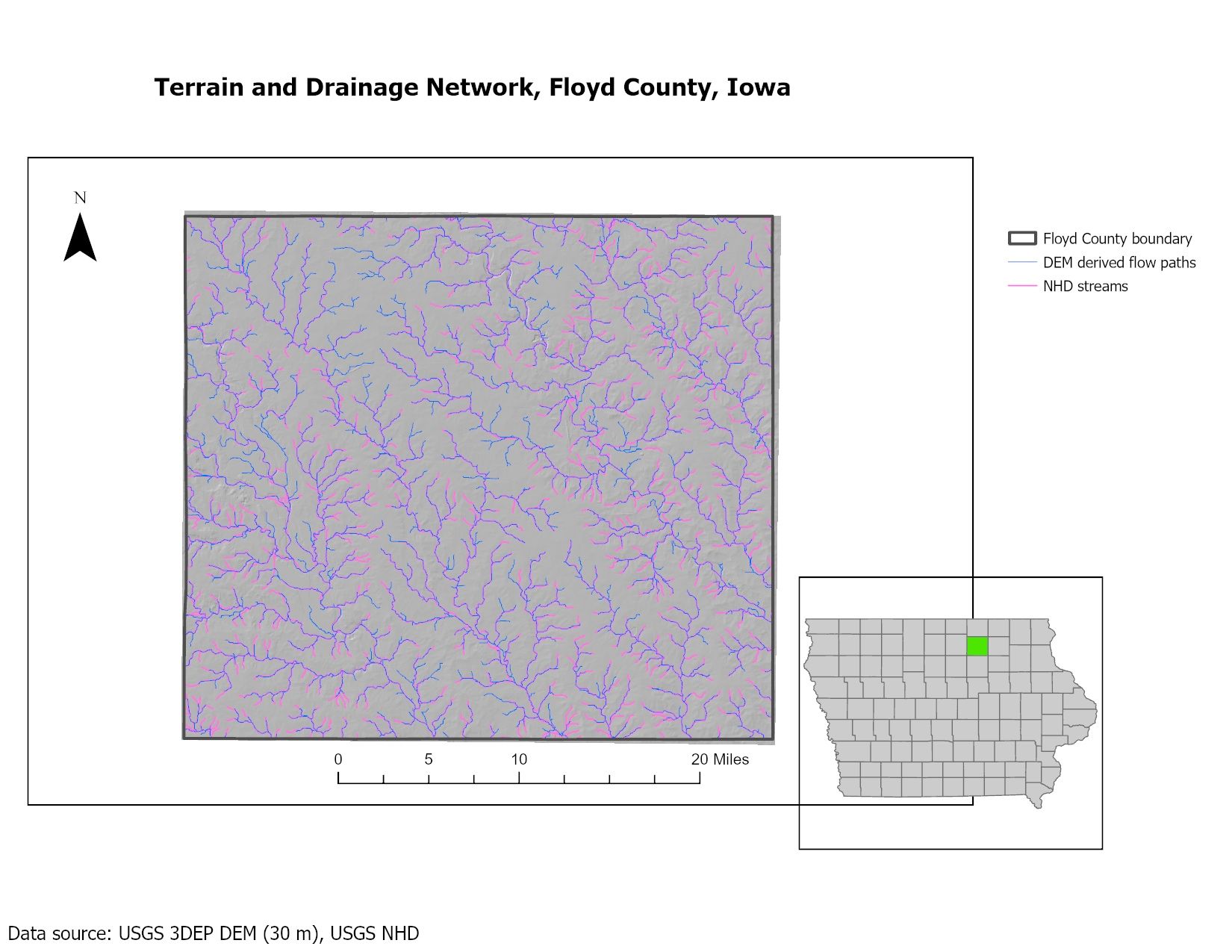
One key finding was that runoff risk was more widespread than erosion risk across corn areas, while erosion risk appeared in more focused patches and hotspot clusters. The final HUC12 priority map helped identify subwatersheds where field verification and conservation planning could begin first.

See the visual in these six poster images:

Meet future teacher Alex Haus

Alex Haus 2025 REU

Every teacher has a story, and everyone who wants to become a teacher has their own inspiration. Learn what drives Alex Haus, a 2025 RegeNPGC “Research Experience for Undergraduates” participant.

Alex Haus, Wartburg College

I grew up in the small town of Charles City, Iowa. I’m a first-year student at Wartburg College (Waverly, Iowa), studying to become a middle school teacher with a focus on grades 5–8 science and math, along with a coaching endorsement. While I’m still gaining experience, I’m passionate about education and excited to help future students grow. I have a twin, and I’ve ridden in RAGBRAI twice, an experience that really challenged and inspired me. In my free time, I love fishing, listening to music, and playing the ukulele.

I applied to the REU program because… of my desire to gain useful experience in math and science that I can bring into my future classroom. As someone who will be teaching middle school in the future, I understand that real-world learning, particularly in STEM, often requires trial and error and, at times, failure. I want to demonstrate to my students that failure is not the end but rather a component of the learning process. I am aware that I will encounter challenges and difficulties in this program, and I am confident that those experiences will improve my teaching abilities. When I tackle challenges on my own, I can assist my students in grasping that making mistakes, looking for assistance, and endurance are all accepted actions. It is just as important to learn how to fail in the future as it is to reach the appropriate response. I desire for my classroom to be a space in which students feel safe, curious, and supported, particularly when challenges arise.

My expectations from the REU program are… to gain real-world experience in science and math from the summer RET/REU program that I can use in my future classroom. I also look forward to the chance to collaborate with others from around the country, working together with people I have yet to meet. I think collaborating with people from various backgrounds and viewpoints will be extremely beneficial. Not only will it assist me in getting new ideas and methods, but it will also prompt me to communicate and resolve issues in ways that may vary from my regular procedures.

Why do you want to become a teacher? My decision to become a STEM teacher stems from a strong desire to learn and share knowledge. STEM topics always attracted my interest because of their ability to tackle current issues and promote creativity. I hope to inspire the next generation of thinkers and innovators by making these topics more approachable and entertaining. Teaching allows you to spark students’ interest, assist them in understanding complex ideas, and promote critical thinking and problem-solving—all of which are essential abilities in any field.

New ideas needed? Find them at RegenPGC!

It’s spring! It’s always a good time to be open to new ideas on managing our land and soil in row crop production. Our @RegenPGC Perennial Groundcover Project does precisely that. We are working on new approaches to a lot of old issues, such as how to:
◼ Reduce soil erosion (reduced P losses)
◼ Reduce water runoff
◼ Increase water infiltration
◼ Improve soil quality
AND
◼ How to achieve greater stover harvest

Our Project Director, Dr. Raj Raman, has some ideas on these topics, which he covers in this video presentation, “Perennial Groundcovers in Corn & Soybean Production Systems: Potential & Scalability.” You can find the video at https://youtu.be/MYQcSBZXVXQ  and the accompanying Field Notes at https://iastate.box.com/s/fij94zkojl6kpaofkmepdk66cpzb0ij3.

New RegenPGC Video Series

We realize some of you may be new to perennial groundcover and its potential for modern #agrictulture. So, we have started a new series to acquaint (or reacquaint) folks with @RegenPGC and our vision for using perennial groundcover in row crop fields for all kinds of interesting benefits.. This first video features Dr. Ken Moore and Roger Hintz, two members RegenPGC Team who have the most experience of anyone trying to manage and maintain yields when incorporating perennial ground cover into a row crop system –so, this video – https://lnkd.in/gbdgz9mQ is for you. (See the accompanying Field Notes at https://lnkd.in/gHQsGpXP)

We acknowledge that some of you may be unfamiliar with perennial groundcover and its potential for modern agriculture. Consequently, we have initiated a new series to educate (or reeducate) folks in the agriculture sector about RegenPGC and our vision for introducing perennial groundcover to the row crop landscape.

This video showcases Dr. Ken Moore and Roger Hintz, two individuals with extensive experience managing and maintaining yields when incorporating perennial ground cover into row crop systems. This video, accessible at https://youtu.be/MYQcSBZXVXQ, and you will find the accompanying Field Notes at https://iastate.box.com/s/fij94zkojl6kpaofkmepdk66cpzb0ij3.

Over the next several weeks, we will be dropping in more from this series into our blog. Stay tuned!


More honors and recognition for the RegenPGC Graduate Education Community

Our 18-member Graduate Education Community (https://www.regenpgc.org/theme-3-education/graduate-education-copy/) never stops impressing us with their dedication to good research and the RegenPGC vision.* But this month shows what an interesting and talented group we have.

Hallie Sandeen (University of Kentucky / Mentor Dr. Erin Haramoto) received a 1st place award at the University of Kentucky’s Integrated Plant & Soil Science Department Fall 2024 Symposium for her poster “Evaluation of Poacae Species and Suppression Application Methods for Permanent Groundcover in Corn.” Earlier this year, Hallie was recognized as the Weed Science Society of America’s 2025 Photographer of the Year! At the Society’s Annual Meeting in Vancouver.

We learned Graduate Student Jack Moran’s (Iowa State University / Mentors Drs. Susan Goggi & Ken Moore) interesting backstory of how he made it from Multyfarnham, Central Ireland, to Iowa State University. Jack’s Iowa State University ‘origin story’ was shared in an article by the ISU College of Agriculture and Life Sciences Office for Global Engagement. You can read “From Exchange Student to a Master’s Degree: a Global Journey to Iowa State University” at https://global.ag.iastate.edu/news/2025/exchange-student-masters-degree-global-journey-iowa-state-university

*Our vision is to create well-adapted PGC systems for a range of farm operations that require low labor inputs, provide significant ecosystem benefits, increase row crop resiliency, and have similar economic profiles as conventional row crop practices.