We believe in the adage that unless work is memorialized, it doesn’t really exist (except in the dark recesses of someone’s mind). This is why you can follow the investment made by our funder, USDA National Institute of Food and Agriculture, in our perennial groundcover research right here in our latest quarterly report, which you can find here.
Check it out. Visit our website. Send us questions to https://www.regenpgc.org/contact/. That way, we won’t think our work shot out into an unfathomable void!
Poa secunda, a Promising Perennial Groundcover?
RegenPGC Graduate Education Community member Vipul Kumar has been showing his poster, “Vernalization response and freezing tolerance of Poa secunda, a promising perennial groundcover” far and wide, from Texas to Wisconsin. You can check his poster out right here! https://www.regenpgc.org/wp-content/uploads/2026/07/Kumar_Vipul_Poster_FINAL-2.pdf.
Working with RegenPGC Co-Project Director Dr. Shui-zhang Fei, Vipul is investigating the feasibility of using Poa secunda as a perennial groundcover. With support from RegenPGC and USDA NIFA, Vipul has presented his work at numerous professional gatherings, where he has received feedback on his research and presentation skills. Learn more about the RegenPGC Graduate Education Community at https://www.regenpgc.org/theme-3-education/graduate-education-copy/.
Mapping priority areas for runoff and erosion control in Iowa corn landscapes
Ralph Danquah-Acquah, a member of our RegenPGC Graduate Education Community, shares his research in this guest post, which previously appeared on LinkedIn (July 2026).
I completed my CRP 5510 GIS final project at Iowa State University, where I developed a GIS-based workflow to map runoff and erosion risk in corn landscapes in Floyd County, Iowa.
The motivation for this project came directly from my ongoing work with the RegenPGC project. My ALMANAC simulation work is connected to the Iowa State University Northeast Research and Demonstration Farm, and since that research location is in Floyd County, I chose Floyd County as the study area for this GIS project.
RegenPGC is exploring how perennial groundcover systems can help make corn production more resilient by reducing runoff, erosion, and other environmental losses. That made me think beyond the field scale and ask a broader spatial question:
If runoff and erosion are major concerns in corn systems, which places should be targeted first?
That question shaped the direction of my project. Instead of only looking at whether a conservation practice can reduce runoff and erosion, I wanted to explore where conservation practices may be most needed across the surrounding agricultural landscape.
The project focused on three main questions:
- Where is runoff risk highest in corn areas?
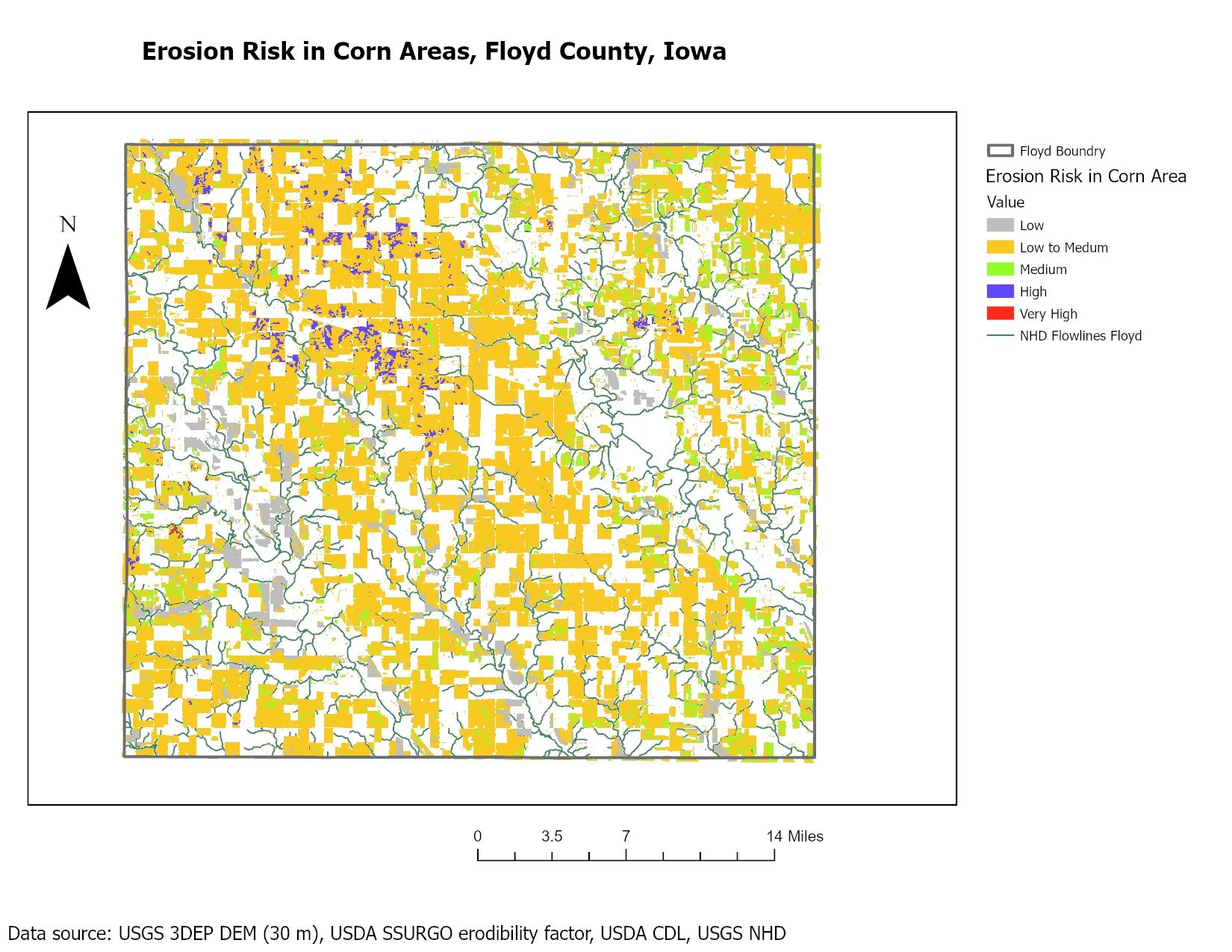
- Where is erosion risk highest in corn areas?
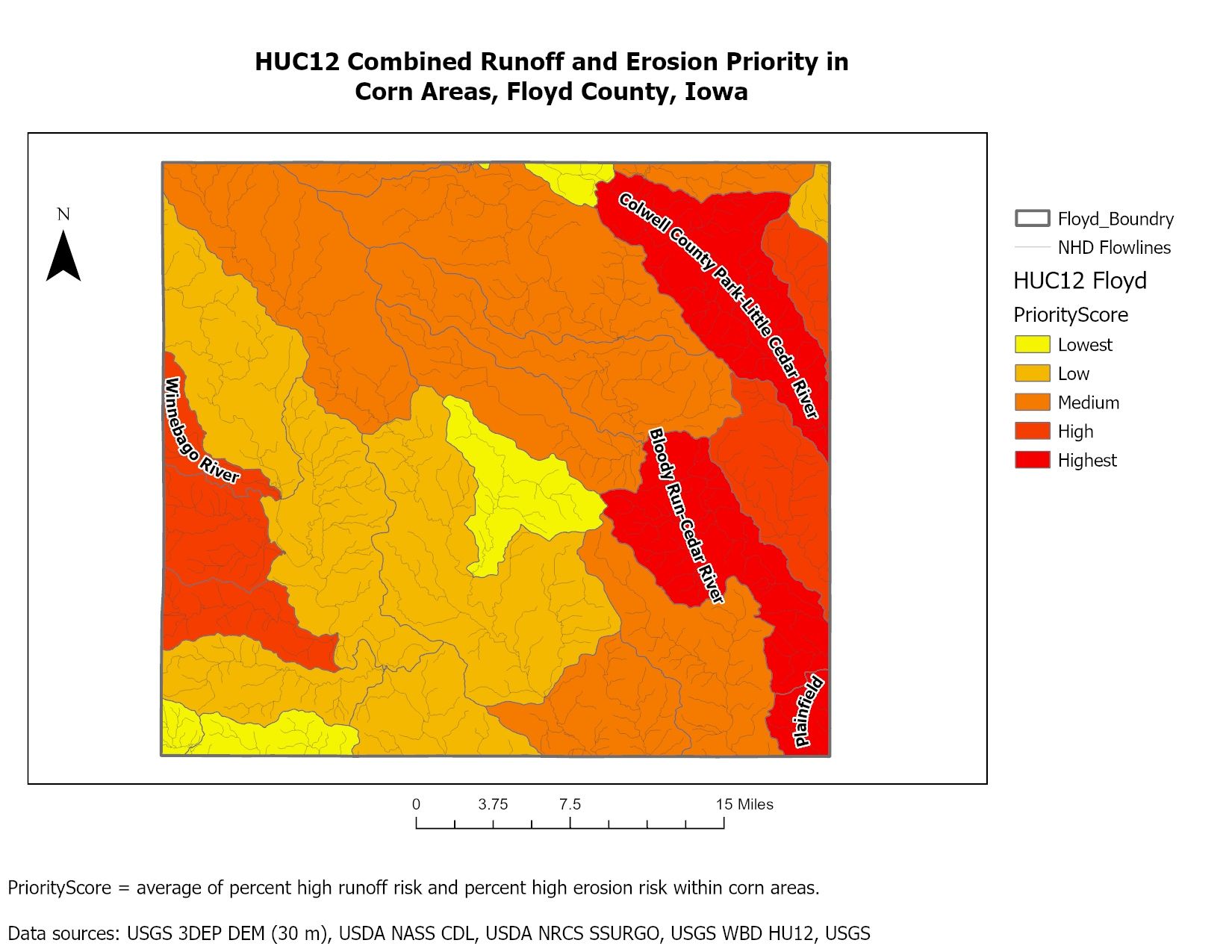
- Which HUC12 subwatersheds contain the largest risk and high-risk corn land?
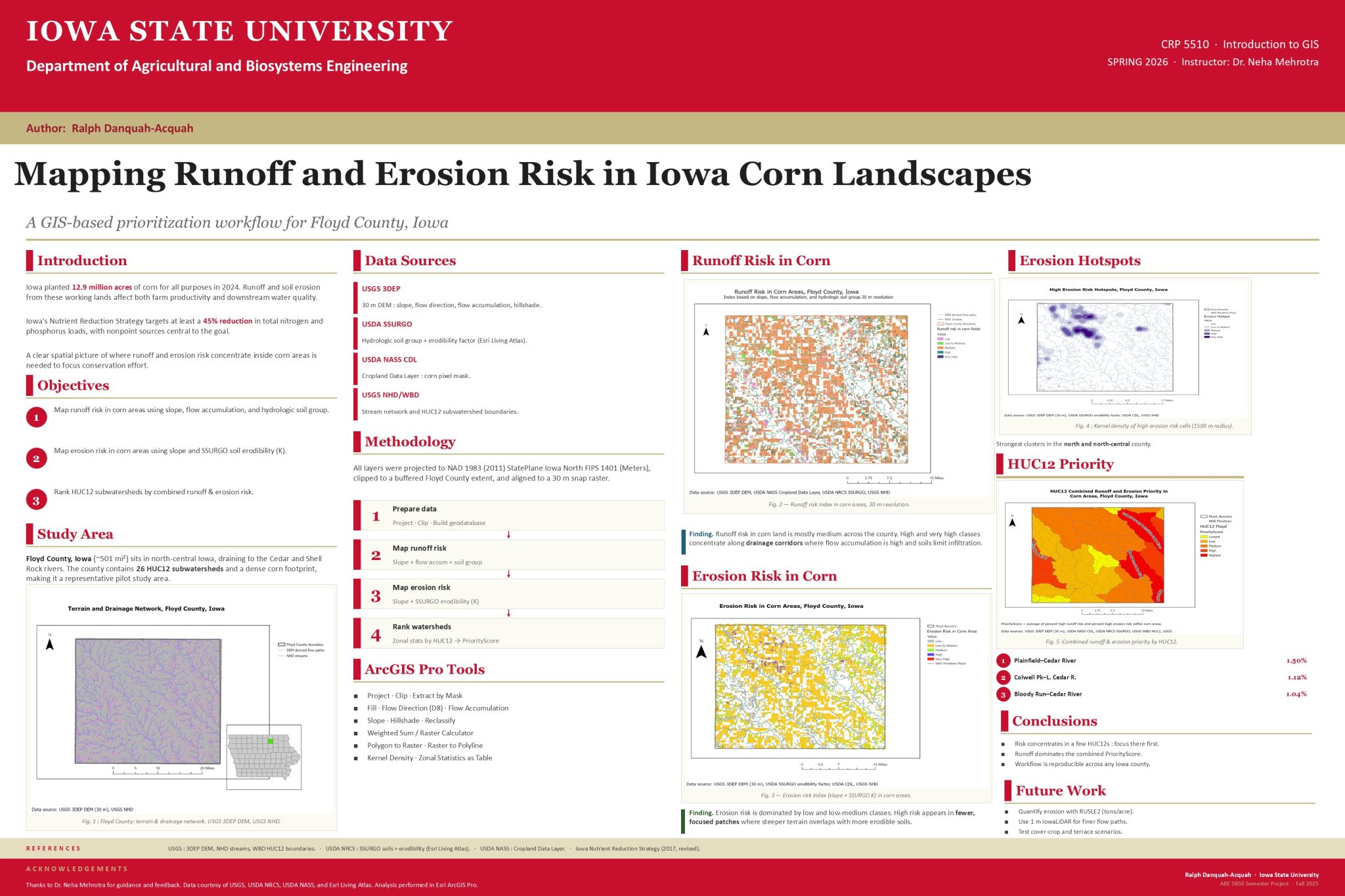
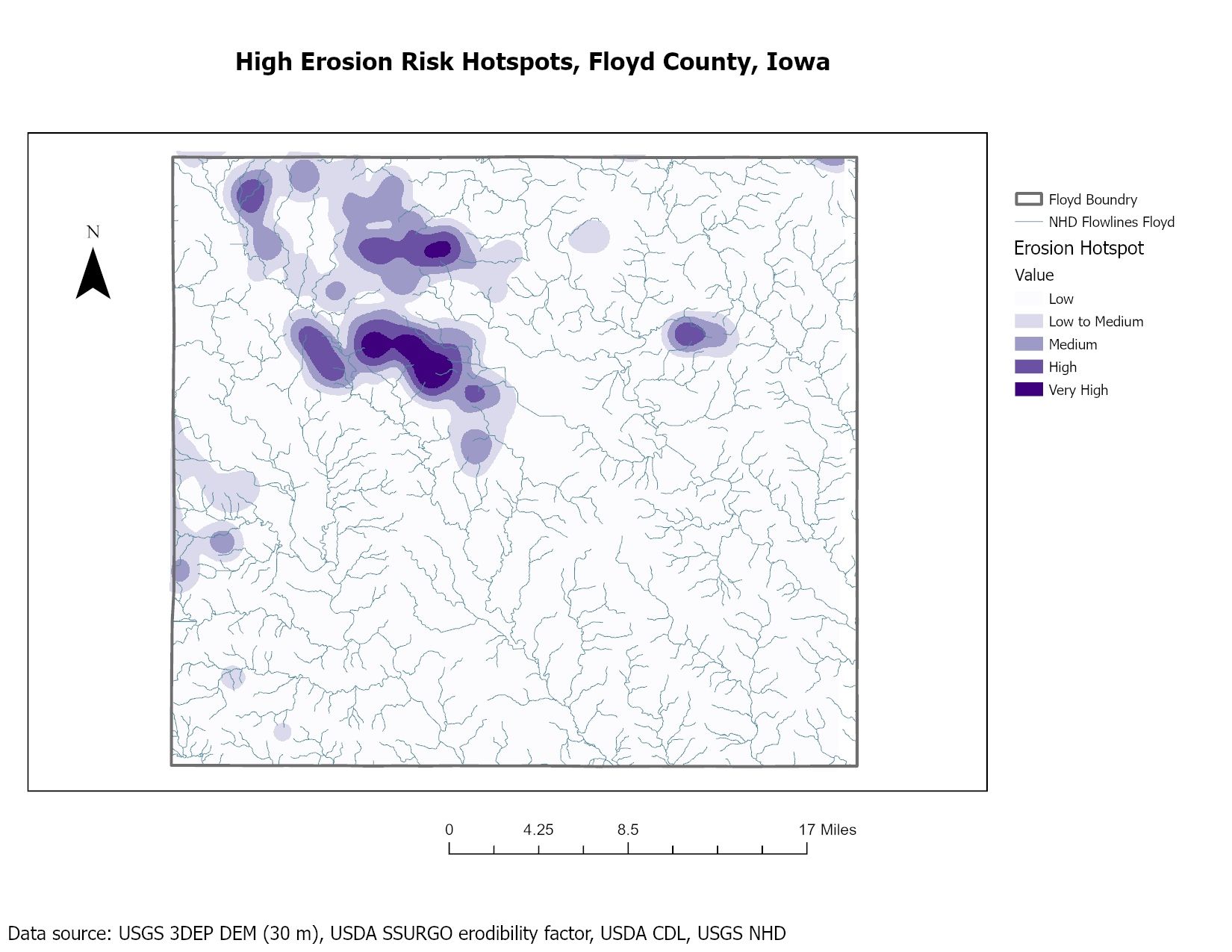
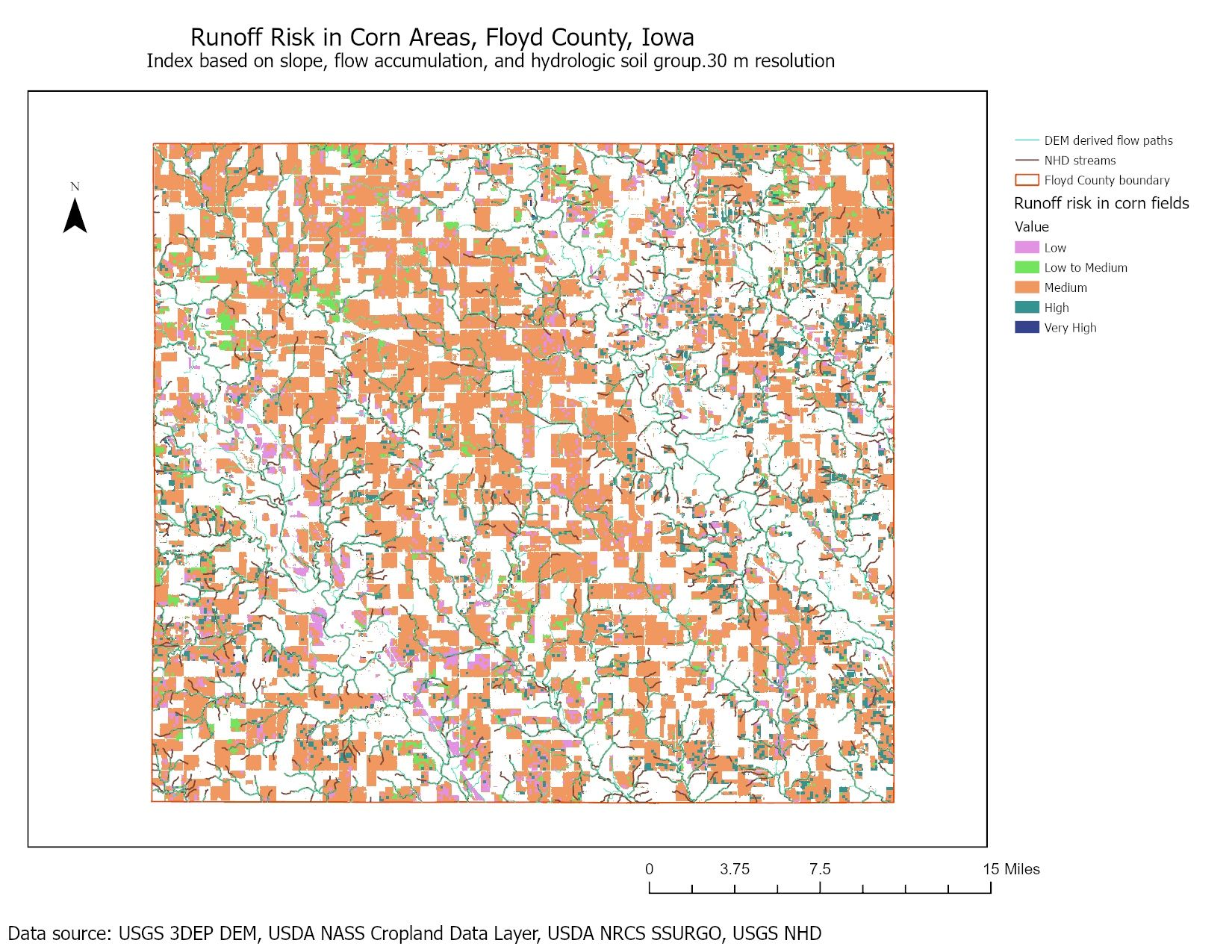
Using ArcGIS Pro, I worked with open geospatial datasets including USGS 3DEP DEM, USDA SSURGO soils, USDA NASS Cropland Data Layer, USGS NHD flowlines, and WBD HUC12 boundaries. I created runoff and erosion risk indices, mapped erosion hotspots, and summarized high-risk corn areas by HUC12 to develop a combined priority score.
One key finding was that runoff risk was more widespread than erosion risk across corn areas, while erosion risk appeared in more focused patches and hotspot clusters. The final HUC12 priority map helped identify subwatersheds where field verification and conservation planning could begin first.
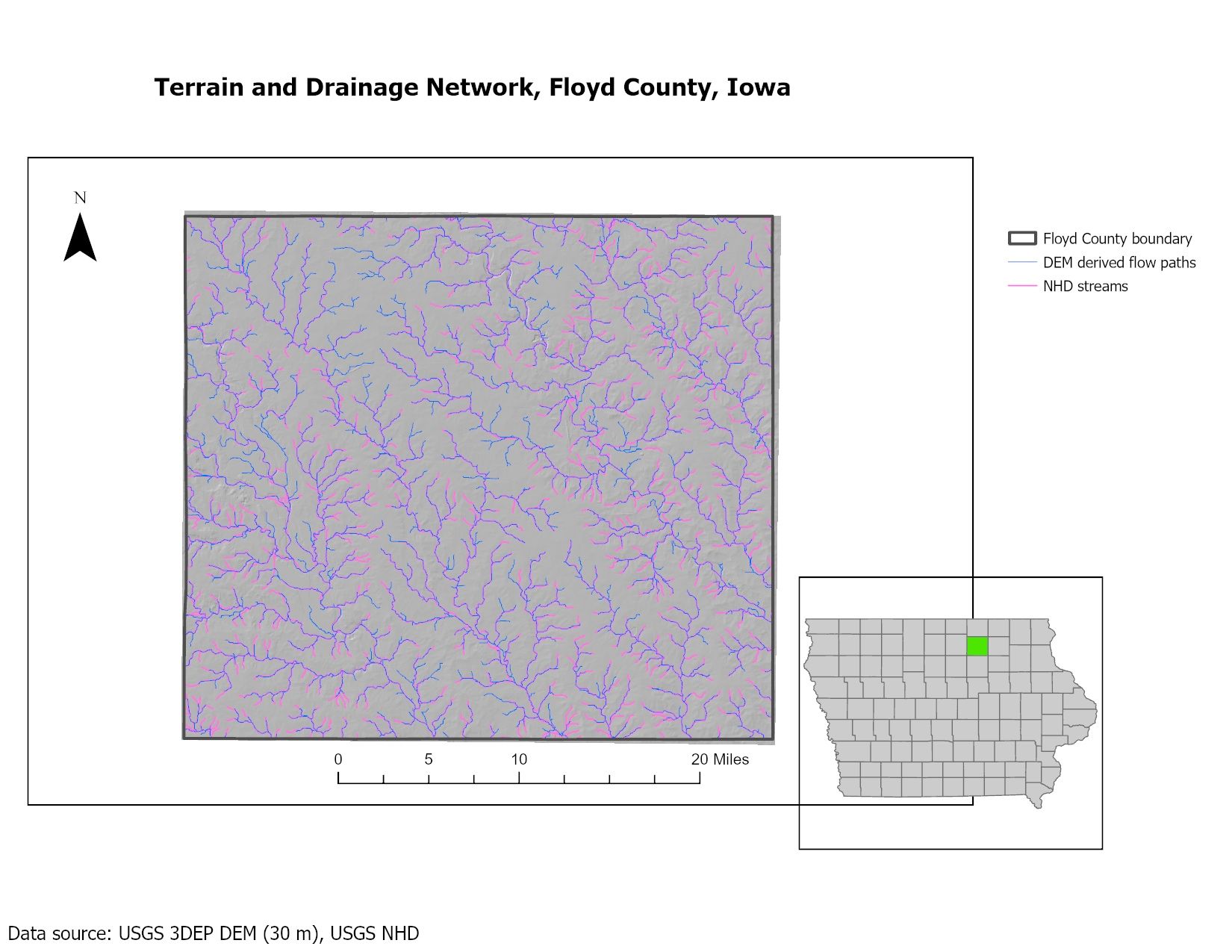
See the visual in these six poster images:
- Poster 1. Mapping Runoff and Erosion Risk in Iowa Corn Landscapes – https://www.regenpgc.org/wp-content/uploads/2026/07/Ralph-1.jpegPoster 2. Terrain and Drainage Network, Floyd County, IA – https://www.regenpgc.org/wp-content/uploads/2026/07/Ralph-2.jpegPoster 3. HUC12 Combined Runoff and Erosion Priority in Corn Areas, Floyd County, IA – https://www.regenpgc.org/wp-content/uploads/2026/07/Ralph-3.jpegPoster 4. Erosion Risk in Corn Areas, Floyd County, IA – https://www.regenpgc.org/wp-content/uploads/2026/07/Ralph-4.jpegPoster 5. High Erosion Risk Hotspots, Floyd County, IA – https://www.regenpgc.org/wp-content/uploads/2026/07/Ralph-5.jpegPoster 6. Runoff Risk in Corn Areas, Floyd County, IA – https://www.regenpgc.org/wp-content/uploads/2026/07/Ralph-6.jpeg
Ralph Danquah-Acquah gets a presentation opportunity
Great to see this opportunity for RegenPGC Graduate Education Community member Ralph Danquah-Acquah to present his poster, Green between the rows: modeling Corn-RhB perennial ground cover systems,” at th at the 2026 Iowa Water Environment Association Annual Conference in Des Moines.* Click here Ralph’s poster.
Ralph’s poster presentation shared his graduate research where, working with his advisor, RegenPGC CoPd Dr. Amy Kaleita, he uses the ALMANAC Simulation Model to evaluate corn-RHb perennial groundcover systems as part of the RegenPGC project. According to Ralph, “Perennial groundcover systems offer a promising way to reduce runoff and soil erosion while maintaining corn production. My work uses the ALMANAC model to compare PGC with conventional and strip tillage systems, with a focus on soil water dynamics, surface runoff, soil erosion, and corn yield performance under different rainfall conditions.”
Overall, Ralph’s work focuses on soil water dynamics, surface runoff, soil erosion, and corn yield performance under perennial groundcover systems.
*Danquah-Acquah, Ralph, & Kaleita, Amy. (2026, June 17). Green Between the Rows: Modeling Corn-RHb Perennial Groundcover Systems [Poster presentation]. 2026 Iowa Water Environment Association Annual Conference, Des Moines, IA, United States. https://www.regenpgc.org/wp-content/uploads/2026/06/IAWEA_Poster_Ralph.pdf.
From Wartburg to Iowa State. Not a long journey if you know what a Wartburg is! Alex Haus, the third member of our 2026 REU class, is a student at Wartburg.
For you non-Iowans, Wartburg is a small liberal arts college in Waverly, Iowa (Learn more about Wartburg). We are so pleased to note that Alex is a returning Research Undergraduate Intern. His experience last year proved so valuable that he is now back to gain even more knowledge from his RegenPGC mentor team. (Learn more about Alex’s 2025 summer)
ALEX HAUS – WARTBURG COLLEGE
Brief Bio. I am currently a junior at Northern Arizona University studying Mathematics and Secondary Education with the goal of becoming a high school math teacher. I grew up in Gilbert and later moved to Flagstaff to attend college. Alongside school, I am also a licensed hairstylist and enjoy doing hair part-time while pursuing my degree.
I recently began my practicum experience, where I have worked in both science and math classrooms, which has strengthened my passion for teaching and working with students.
Outside of academics and work, I enjoy watching movies and TV shows, working out, and spending quality time with friends and family. Something unexpected about me is that even though I am a huge math enthusiast, geometry is actually my least favorite area of math.
Why I applied… I applied again to meet new people and build meaningful connections, because last year I met some amazing individuals and had a truly positive experience. Last time, the program provided me with valuable knowledge, new perspectives, and strong relationships, and I am hoping to continue building on that experience. I want to keep growing by learning from others, challenging myself in a new environment, and gaining skills that will support me throughout my college experience and future career.
My expectations for the REU program include… My expectations for the summer RET/REU program include gaining hands-on research experience, building meaningful connections, and finding opportunities to thrive in a new and challenging environment. I want to push myself to grow both personally and academically while learning from others and developing skills that will support me in my future career in education.
From Arizona to Iowa: Meet Kaylee
From sunny and DRY Arizona to humid Iowa can be a bit of schock in the summer, but having met 2026 Research Undergraduate Intern and future math teacher Kaylee Johnson, we are sure she will take the change in stride.
Kaylee comes to Iowa State University from Northern Arizona University. Here at ISU, Kaylee will work with RegenPGC Collaborator, Dr. Richard Roth and the staff at the Iowa State University Biotechnology Outreach Education Center. We look forward to an excellent summer experience for Kaylee and the entire REU class!
Meet Research Intern Kaylee Johnson
From North Carolina to ISU – Meet Preston
It’s summer, and we welcome another class of Undergraduate Research Interns. This year we have three interns. Today, meet Preston Marrable from North Carolina Agricultural and Technical State University. Preston will be working with RegenPGC CoPD Dr. Shuizhang Fei.
Preston’s goals for the summer are to “gain more knowledge and strengthen my work ethic and attention to detail. As much as I want to improve on a professional level, I also want to build friendly relationships with my fellow peers.”
We are pleased to welcome Preston to Iowa State University, where we know he will learn a lot with Dr. Fei!
Meet Preston Marrable
Brief Bio. I grew up in Los Angeles while moving around Southern California as a kid. I currently live in North Carolina, and I attend North Carolina Ag & Tech State University as a rising junior. My favorite subjects are English and History. My personal hobbies are cooking, exercise, and listening to music. Something unexpected about me is that I went to Japan last year, and I enjoyed every minute of it.
Why I applied… I applied to the program because I want to gain research experience in STEM and mathematics. I also want to gain professional insight and experience by building a coalition of connections among my Iowa State colleagues before, during, and after the program has finished.
My expectations for the REU program include… I want to gain more knowledge and strengthen my work ethic and attention to detail. As much as I want to improve on a professional level, I also want to build friendly relationships with my fellow peers.
Welcome, Gabriel!
We are excited to welcome a new member to the RegenPGC team, Gabriel J. Gabriel comes to our project from The Land Institute, where he is a new Agronomical Data Scientist. Gabe joins the Land Institute to help advance their Perennial Legume program into a more fully data-enabled platform by building systems for data curation and long-term accessibility, developing web-based tools for analysis, and enabling real-time, decision-driven insights.
At RegenPGC, he will apply those skills to working witho ur team, especially members of the Graduate Education Community.
He brings valuable experience from Corteva Agriscience, where he worked as a Research Investigator on the Cropping Systems team and collaborated with Bo Meyering and the broader RegenPGC initiative to develop data management systems and image analysis models. Gabe also holds a master’s degree from Oklahoma State University. The Land Institute says, “We are thrilled to have him on the team and look forward to the impact his modeling and data science expertise and manuscript preparation will have on accelerating our work”
New RegenPGC publication hits the “Streamosphere”
RegenPGC Ph.D. student Memiş Bilgici, joined by RegenPGC colleagues Sara Lira, Lucas Borras, Ken Moore & Thomas Lübberstedt, has authored a new academic publication for the academic journal Frontiers in Plant Science.
The article, Trends in stomatal density and size in maize hybrids representing 100 years of long-term breeding for yield* highlights four main research findings:
- Modern hybrids had higher stomatal density but lower total stomatal pore area than historical hybrids.
- Across 27 Pioneer hybrids, stomatal density was negatively correlated with stomatal size, length, width, and leaf area.
- Over the past 100 years, the total stomatal pore area on leaves decreased, while stomatal density increased as leaf area declined, revealing a connection between these two patterns.
- Total stomatal pore area was negatively correlated with release-year atmospheric CO2 concentration and temperature anomaly (°C) over the past century.
According to Memiş, “To the best of our knowledge, this is the first crop-focused study to show century-scale changes in stomatal traits associated with long-term maize breeding for yield.”
*Bilgici, Memiş, Ebrahimi, Elnaz, Prada de Miranda, Leticia, Lira, Sara, Borras, Lucas, Young, Thomas, Yavuz, Recep, Moore, Kenneth J., Dixon, Philip, & Lübberstedt, Thomas. (2026). Trends in stomatal density and size in maize hybrids spanning 100 years of long-term yield breeding. Front. Plant Sci., 17:1829321. https://doi.org/10.3389/fpls.2026.1829321
New research informs how corn and perennial groundcover can coexist
Today, we honor RegenPGC Graduate Education Community member Amina Moro and her work on corn’s “Shade Avoidance Response.” Iowa State University – College of Agriculture and Life Sciences recognized Amina’s work by featuring her in the article, “New research shows finding the ‘sweet spot’ is key to successful groundcover systems.” See: https://www.cals.iastate.edu/news/2026/new-research-shows-finding-sweet-spot-key-successful-groundcover-systems
Amina’s work informs how corn behaves when perennial groundcover is located in proximity to it. As the article specifies, “The practical applications of this research are clear. By maintaining a small buffer zone – around 25 centimeters – farmers can prevent early stress signals in corn while still benefiting from soil protection.”
According to Amina, “Farmers do not have to choose between improving soil health and maintaining yield,” Moro said. “With the right combination of spacing, hybrid selection, and management practices, it is possible to design systems where corn grows efficiently while the soil remains protected.”
Learn more about the science behind Amina’s work in her recently published paper in the Journal of Agronomy, “Spatial Proximity to Perennial Groundcover Triggers Shade Avoidance Responses in Corn” (https://www.mdpi.com/2073-4395/16/7/729).